Complete Guide to Nepal Income Tax Act 2058: Slabs (FY 2083/84 & Historical), Salary Breakdown, Deductions, TDS & Corporate Tax Architecture
An exhaustive, master-class guide to Nepal's Income Tax Act 2058 (2002). Explore the modern unified FY 2083/84 tax slabs, multi-decade historical tax evolution, 12-month payroll schedule (Statements 3 & 4), allowable deductions (EPF, CIT, SSF, Insurance), 5% tech freelancer tax, final vs non-final TDS, corporate tax rates, and statutory penalties.
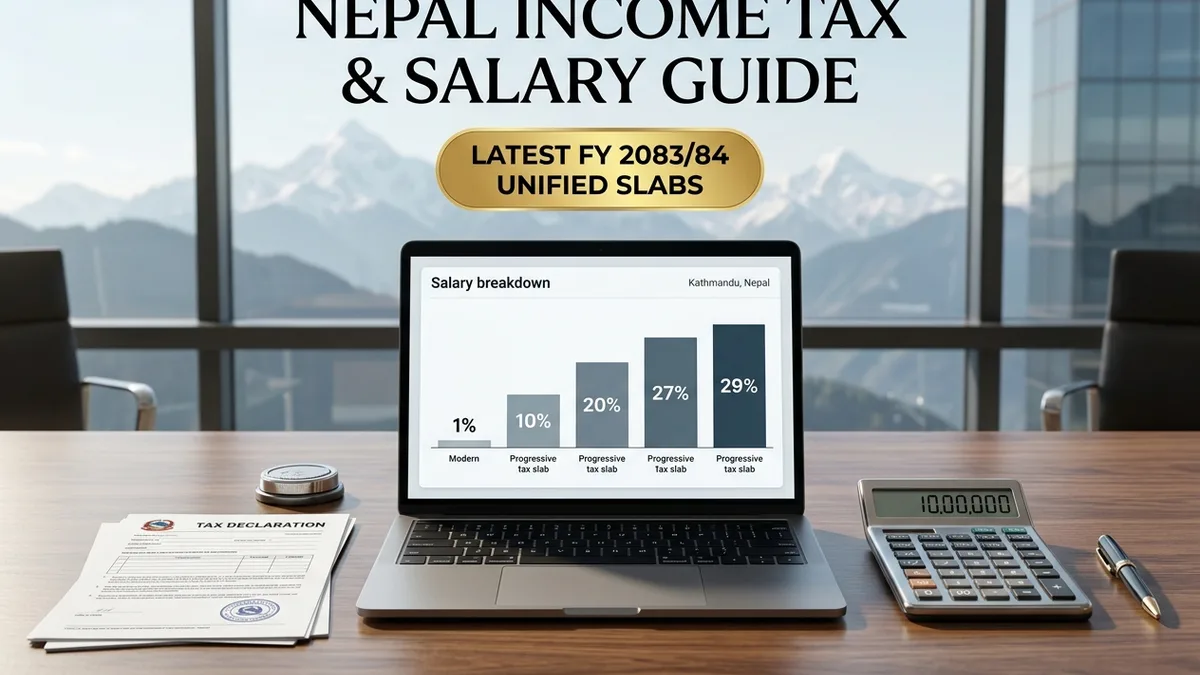
Navigating the taxation landscape of Nepal requires a precise understanding of the primary legislation governing both individuals and corporations: the Income Tax Act, 2058 (2002). From the historic transformation of individual progressive tax slabs in FY 2083/84 (2026/27) to intricate monthly payroll schedules (Statements 3 & 4), allowable retirement deductions, 5% digital exporter concessions, and final Withholding Taxes (TDS), this authoritative guide provides the deepest possible analysis of Nepal’s tax regime.
Calculate Your Nepal Salary & Income Tax Instantly
Skip complex manual formulas. Our browser-based, client-side financial tools give you instant calculations according to official IRD progressive slabs and 12-month civil service payroll mechanics.
1 Foundations of the Income Tax Act, 2058 (2002)
The statutory foundation for all direct income-based taxation within the Federal Democratic Republic of Nepal is enacted under the Income Tax Act, 2058 (2002), which formally came into legal effect on 19 Chaitra 2058 (April 1, 2002). It is accompanied by the subordinate Income Tax Rules, 2059 (2003) and continually reshaped through annual Finance Acts (Aarthik Ain) promulgated alongside the federal budget.
Classification of Taxpayers
The legislative architecture categorizes every taxable person into one of two fundamental taxpayer classifications:
- Natural Persons (Individuals): Encompasses biological human beings, sole proprietorship registered firms, and undivided Hindu families (HUF). Natural persons are evaluated under a progressive marginal slab system where higher tiers of income face escalating percentage rates.
- Entities (Corporate Bodies): Includes private limited companies, public limited corporations, registered partnership firms, cooperative societies, state-owned enterprises, and permanent establishments (PE) of foreign non-resident enterprises. Entities are taxed on a flat proportion of net accounting profit rather than graduated brackets.
Residential Status Framework (Section 110)
Under Nepalese tax jurisprudence, tax obligations are dictated strictly by residential status, not citizenship. A foreign expat working in Kathmandu can be treated as a resident, while a Nepali citizen residing abroad can be classified as a non-resident.
An individual is legally deemed a tax resident if they spend 182 days or more inside Nepal within any continuous 365-day fiscal period, or if their habitual place of abode is located within Nepal. Residents are taxed on their worldwide income, necessitating full domestic disclosure of foreign wages, overseas bank interest, and international asset capital gains.
Individuals who fail to cross the 182-day physical presence threshold are non-residents. Non-residents are taxed strictly on income generated, accrued, or sourced within the geographical boundaries of Nepal. They are barred from progressive slabs and pay a flat 25% on gross domestic income.
The Nepalese Fiscal Year Layout
Distinct from western Gregorian calendar models (January to December or April to March), the Nepalese fiscal year operates on the official Bikram Sambat (BS) astronomical calendar:
- Starts: Shrawan 1st (साउन १ गते) — approximately mid-July.
- Concludes: Ashadh end (असार मसान्त) — approximately mid-July of the following calendar year.
2 Comprehensive Individual Tax Slabs: Current Matrix & Historical Evolution
The Modern Standard: FY 2083/84 (2026/2027) Onwards
The Finance Act introduced a historic consolidation of the personal tax regime. The decades-old dual-track system ("Single Individual" vs. "Married Couple") was replaced by a unified progressive taxation schedule applicable uniformly to all resident natural persons:
| Tier | Taxable Income Bracket (कर स्ल्याब) | Marginal Rate | Maximum Tax in Slab | Statutory Treatment & Notes |
|---|---|---|---|---|
| Tier 1 | Up to Rs. 10,00,000 (पहिलो १० लाख) | 1% | Rs. 10,000 | Designated as Social Security Tax (SST) for salaried employment. 0% waiver if enrolled in SSF; 0% for business proprietorships & pensions. |
| Tier 2 | Rs. 10,00,001 to Rs. 15,00,000 (Next 5L) | 10% | Rs. 50,000 | Applies strictly to income falling within this Rs. 5 Lakh window. |
| Tier 3 | Rs. 15,00,001 to Rs. 25,00,000 (Next 10L) | 20% | Rs. 2,00,000 | Applies strictly to income falling within this Rs. 10 Lakh window. |
| Tier 4 | Rs. 25,00,001 to Rs. 40,00,000 (Next 15L) | 27% | Rs. 4,05,000 | High-middle income bracket. |
| Tier 5 | Above Rs. 40,00,000 (४० लाख भन्दा माथि) | 29% | No Cap | Peak marginal ceiling rate on all residual volume. |
Historical Evolution of Nepal Personal Income Tax Slabs
To understand where your historic tax filings or multi-year audits stand, examine the progression of tax brackets across prior fiscal years:
The High-Tax Phase: FY 2080/81 to FY 2082/83 (Peak 39% Bracket) 6 Slabs
Introduced a super-bracket penalizing earnings over Rs. 50 Lakhs with an unprecedented 39% marginal rate (36% standard + 3% surcharge):
Individual: Up to 5L @ 1%, 5L-7L @ 10%, 7L-10L @ 20%, 10L-20L @ 30%, Above 20L @ 36%.
Couple: Up to 6L @ 1%, 6L-8L @ 10%, 8L-11L @ 20%, 11L-20L @ 30%, Above 20L @ 36%.
Individual: Up to 4L @ 1%, 4L-5L @ 10%, 5L-7L @ 20%, 7L-20L @ 30%, Above 20L @ 36%.
Couple: Up to 4.5L @ 1%, 4.5L-5.5L @ 10%, 5.5L-7.5L @ 20%, 7.5L-20L @ 30%, Above 20L @ 36%.
Individual: Up to 3.5L @ 1%, 3.5L-4.5L @ 15%, 4.5L-25L @ 25%, Above 25L @ 35%.
Couple: Up to 4L @ 1%, 4L-5L @ 15%, 5L-25L @ 25%, Above 25L @ 35%.
3 Deep-Dive: Individual Deductions, Reliefs & Statutory Rebates
Every rupee of tax reduction stems from knowing how to accurately claim statutory reliefs specified under the Income Tax Act:
1. Approved Retirement Fund (ARF) Allocations (Section 63)
Employees contributing to the Employee Provident Fund (EPF/Sanchaya Kosh), Citizen Investment Trust (CIT/Nagarik Lagani Kosh), or the Social Security Fund (SSF) can deduct contributions from assessable income. The legal deduction is strictly the lowest of:
Total contributions deposited during the fiscal year.
Exactly 1/3rd (33.33%) of total gross assessable income.
Rs. 5,00,000 annually if enrolled in SSF; otherwise Rs. 3,00,000 for legacy funds.
2. Insurance Premium Deductions (Schedule 1)
- Life Insurance: Deduct actual premium paid up to a hard legal ceiling of Rs. 40,000 per year (increased from the older Rs. 25,000 cap).
- Health & Medical Insurance: Deduct actual premium paid up to a hard legal ceiling of Rs. 20,000 per year.
- Private Residential Building Insurance: To encourage earthquake/disaster risk mitigation on private homes, premiums are deductible up to a statutory ceiling of Rs. 10,00,000 (or actual premium), with property tax concessions capped at Rs. 5,000.
3. The Medical Tax Credit Mechanism (Section 51)
Unlike standard deductions that lower taxable income, the Medical Tax Credit directly reduces your final computed tax liability. Taxpayers can claim 15% of approved hospital bills, subject to a hard statutory cap of Rs. 1,500 per year. Any unused credit can be carried forward indefinitely. Proviso: You cannot claim this credit if the medical expenses were already reimbursed or claimed under health insurance.
4. The Salaried Female Tax Rebate (10% Discount) & The Forfeiture Trap
Resident female natural persons deriving income strictly and exclusively from employment remuneration receive an automatic 10% direct discount off their final calculated tax liability.
5. Special Threshold Expansions for Vulnerable Groups
- Incapacitated & Disabled Taxpayers: Certified disabled natural persons receive a 50% expansion on their first baseline tax slab (e.g., in FY 2083/84, Rs. 10 Lakh expands to Rs. 15 Lakh).
- Pension Income Relief: Monthly formal pension recipients receive an extra deduction of 25% of the standard primary base slab or actual pension income, shielding core post-retirement funds from tax.
6. Geographical Remote Area Allowances (दुर्गम क्षेत्र सहुलियत)
Professionals stationed in remote regions receive flat deductions expanding their first tax-exempt slab:
Rs. 50,000
Rs. 40,000
Rs. 30,000
Rs. 20,000
Rs. 10,000
Note: Full claim requires posting for the entire 365 days; otherwise calculated pro-rata on daily basis.
7. Foreign Diplomatic Service Concession
Nepali citizens posted in diplomatic missions, embassies, and consulates overseas receive an exclusive 75% exclusion on foreign living allowances and adjustments; only the remaining 25% is subject to standard progressive tax rates.
4 Special Provisions: Freelancers, Digital Earners & Capital Asset Markets
1. Freelancers, Tech Exporters & Remote Content Creators (5% Final TDS)
To encourage formal foreign currency inflows through banking channels, software developers, YouTube creators, IT consultants, and remote service providers are granted a flat 5% final withholding tax on inward foreign remittance.
2. Capital Gains Tax (CGT) on Listed Securities (NEPSE)
Retail investors disposing of equities on the Nepal Stock Exchange (NEPSE) face final withholding deducted automatically by stockbrokers and CDSC:
10% Final TDS on net capital gain.
7.5% Final TDS on net capital gain.
3. Real Estate, Land & Housing Capital Gains Traps
Gains on disposal of land and residential property are taxed at the Land Revenue Office (Malpot) prior to deed registration:
10% Final CGT on declared profit.
7.5% Final CGT on declared profit.
5 Demystifying Withholding Tax: Final vs. Non-Final TDS
One of the most frequent accounting pitfalls in Nepal is conflating Final Withholding with Non-Final Advance Withholding:
| Final Withholding Tax (अन्तिम कर कट्टी) | Non-Final Withholding Tax (अग्रिम कर कट्टी) |
|---|---|
| • Tax obligation is fully settled at the moment of payment. | • Treated as an advance tax prepayment credit (Asset). |
| • Excluded from year-end progressive income assessment. | • Must be added to annual gross income in tax returns. |
| • No further tax or refund can ever be claimed. | • Offset against final tax liability via Annex 10 withholding slips. |
6 Corporate & Enterprise Taxation Architecture
Unlike individuals, business entities are taxed at flat rates determined by industry classification:
General trading enterprises, private limited companies, services, and construction contractors.
Banks/BFIs, Insurance companies, Telecommunications/ISPs, Tobacco, Liquor, and Petroleum distributors.
Manufacturing entities employing native citizens receive a 20% rebate on standard corporate tax.
- Hydropower & Infrastructure: 100% full tax holiday for the first 10 commercial operating years, followed by 50% tax exemption for the subsequent 5 years.
- IT Service Exporters: Registered IT companies exporting digital services receive a 50% income tax exemption (effective corporate tax rate = 12.5%).
- Presumptive Turnover Tax (Small Business): Annual turnover < Rs. 30 Lakh and income < Rs. 3 Lakh pay flat municipal tax: Rs. 7,500 (Metropolitan), Rs. 4,000 (Nagarpalika), and Rs. 2,500 (Gaunpalika).
- Loss Carry-Forward: Normal business losses can be carried forward for 7 consecutive years. Special infrastructure/energy/mineral projects can carry forward losses for up to 12 consecutive years.
7 Penalties, Fines, and Enforcement Actions (Chapter 22)
The Inland Revenue Department (IRD) enforces rigorous punitive consequences under Chapter 22 for delayed filing and tax evasion:
Corporate entities face a fine of Rs. 5,000 per missing return or 0.1% of gross turnover (whichever is higher). Individuals face penalties of Rs. 100 to Rs. 500 per month of delay.
Taxpayers paying estimated tax in three installments (Poush, Chaitra, Ashadh) who fail to pay at least 90% of final tax liability incur an interest charge of 15% per annum on the deficit balance.
Missing the year-end payment deadline incurs an automatic interest charge of 15% per annum running from the due date until the exact settlement date.
• Negligent Misstatement: 50% penalty on underpayment.
• Deliberate Fraud & Fake Books: 100% penalty (double tax) alongside criminal prosecution and potential imprisonment.
Simplify Your Tax & Payroll Calculations with Grisma Info
Whether you are a civil servant verifying your 12-month salary statement (Statements 3 & 4), a private sector employee checking monthly TDS, or a freelancer receiving inward foreign currency, our specialized tools make calculations instantaneous, accurate, and completely private in your browser.
12-month schedule for basic pay, grade scales, allowances, and net take-home bank cash.
Real-time progressive tax slab breakdown for FY 2083/84 & 2081/82 with deductions.
Generate downloadable, official IRD-ready PDF tax deduction certificates and salary sheets.